
Multi Technology
Enabling Condition‑Based Maintenance through Digital Corrosion Inspection
Corrosion management
in brief
Looking Ahead
Corrosion management
Corrosion management
Corrosion management is a cross‑industry challenge affecting industrial plants, infrastructure, utilities, transport, maritime assets, and energy systems alike. Across sectors, corrosion assessments are still largely based on periodic visual inspections and manual reporting, making results difficult to compare, reproduce, and reuse across inspection cycles. Further, when assets are large and complex, the associated workload of inspection and management of inspection date increases exponentially, making corrosion a problem of scale.
Traditional inspection practices often result in isolated observations rather than structured condition data. Individual corrosion observations may be difficult to relocate, documentation formats vary, and changes in condition between inspections are rarely quantified in a consistent way.
By introducing standardized digital inspection workflows and structured condition data, corrosion management can evolve from reactive response toward condition‑based and proactive maintenance. This enables inspection results to support maintenance planning, prioritization, and lifecycle decisions in line with asset management and condition monitoring principles.
in brief
IPU - R&D’s Strongest Ally
A Digital Foundation for Corrosion Decisions
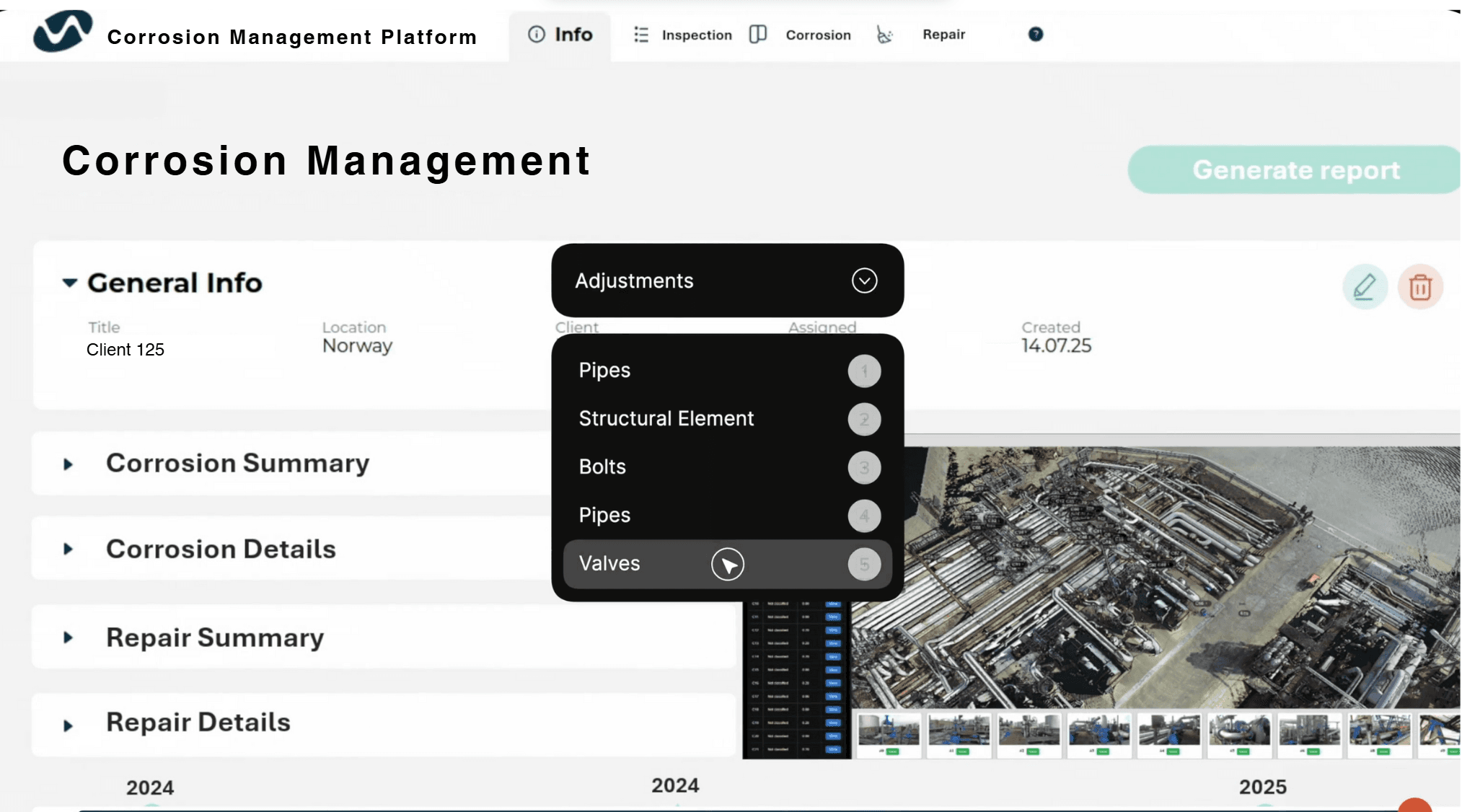
IPU’s corrosion management solution establishes a consistent digital inspection record that supports identification, documentation, and reidentification of corrosion observations across multiple inspection campaigns. Corrosion observations are associated with visual evidence, spatial reference, and structured metadata, allowing the same areas to be reliably revisited during subsequent inspections. This enables direct comparison of condition over time and provides traceable data on changes since the previous inspection. This structured and repeatable inspection data forms the basis for condition monitoring and predictive maintenance planning, supporting decisions based on coherent data of observed development rather than isolated observations.
IPU’s Engineering Approach
IPU combines deep corrosion and materials expertise with strong capabilities in computer vision, AI, and algorithm development, aligned with industrial inspection and condition monitoring requirements. Rather than treating image analysis as a standalone technology, IPU develops integrated solutions where vision, AI, data structures, and engineering judgment support inspection, assessment, and planning activities. Emphasis is placed on transparency, traceability, and usability, ensuring that digital methods can be trusted in operational and safety‑critical environments. Solutions are developed in close collaboration with end users, ensuring alignment with inspection procedures, decision hierarchies, and asset management systems.
Automated Detection and Classification
The degree of automation is adapted to the inspection context and the criticality of the asset. In some applications, corrosion identification and classification are performed automatically using trained image analysis algorithms. In higher‑criticality or regulated environments, detection can be operator‑assisted, where algorithms support inspectors by highlighting potential observations while final classification remains under human control. This approach reflects established inspection practice, balancing efficiency, repeatability, and expert validation in accordance with inspection and condition assessment standards.
3D Context and Condition Tracking
Corrosion observations are positioned within a 3D representation of the asset, providing unambiguous location reference for follow‑up inspection, repair, and verification activities. After maintenance or repair, previously recorded corrosion observations may be marked as repaired in the system. This supports clear documentation, verification of corrective actions, and historical traceability, ensuring that repaired areas are distinguished from new observations during future inspections. Combined with structured inspection history, this spatial and temporal context supports condition tracking and maintenance planning consistent with condition monitoring principles.

Looking Ahead
Looking Ahead: From Platform to Operational Standard
With the technical feasibility and inspection value demonstrated, the corrosion management platform is ready to move beyond pilot use and into broader operational deployment.
The solution is designed to be adapted to different asset classes, inspection regimes, and criticality levels - supporting both regulated and non-regulated environments. Its modular structure enables alignment with existing inspection procedures, condition monitoring programmes, and asset management systems.
IPU typically engages with:
- Asset owners and operators seeking more consistent and traceable corrosion inspection data
- Maintenance and inspection service providers aiming to increase efficiency while maintaining inspection integrity
- Software and system providers looking to integrate structured corrosion data into asset management, CMMS, or ERP platforms
The objective is not to replace established inspection practice, but to strengthen it—by providing better data continuity, comparability over time, and decision support for maintenance planning.
Why IPU?
IPU exists to make advanced technology work in practice.
For decades, we have helped industry turn complex engineering challenges into solutions that can be implemented, operated, and trusted. Our strength lies in combining deep technical insight with the ability to translate new methods, such as computer vision, AI, and data‑driven engineering, into tools that fit real workflows, real constraints, and real decision‑making.
In corrosion management, this means more than building software. It means understanding inspection practice, criticality, data integrity, and how digital tools must support, not disrupt, maintenance and asset management processes.
IPU help organisations adopt new technology with confidence, ensuring that innovation strengthens inspection quality, operational reliability, and long‑term asset decisions. IPU is R&D’s strongest ally.